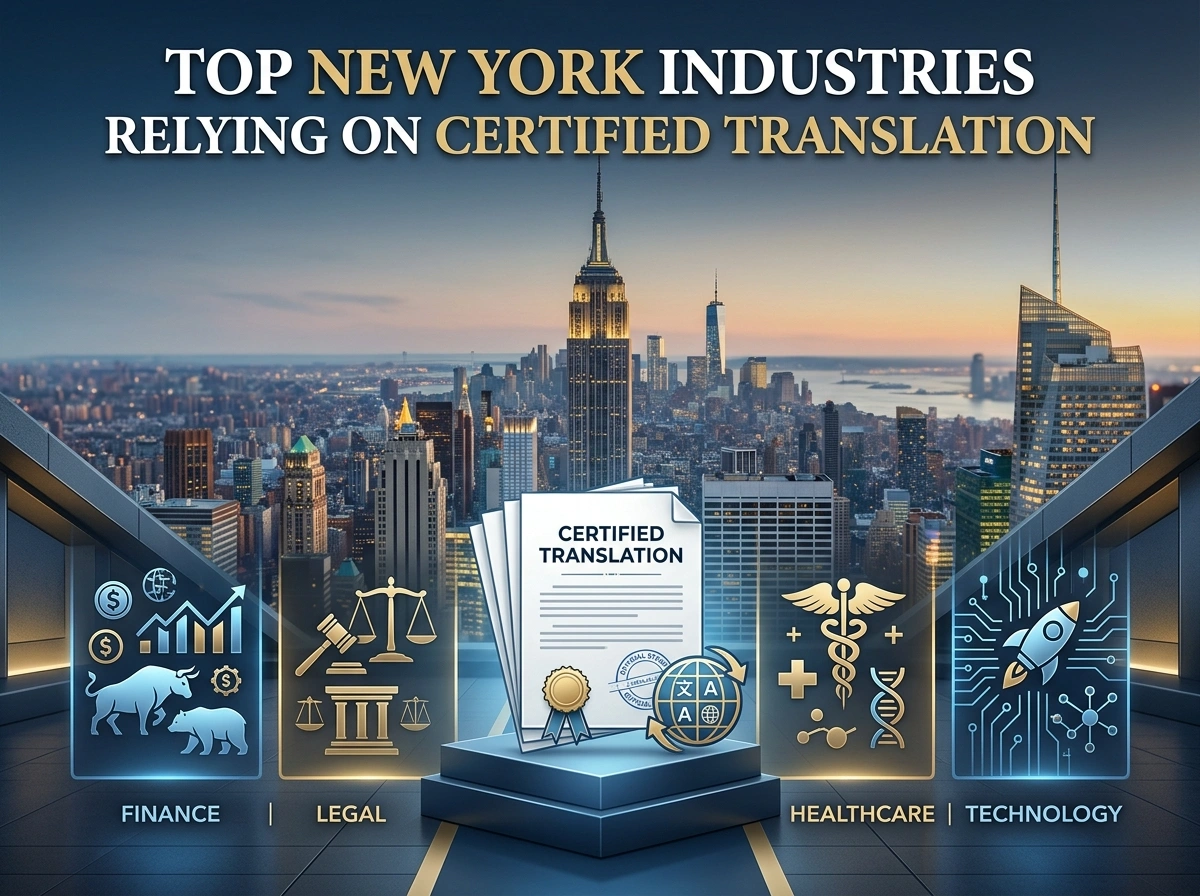
New York City stands as a global hub of commerce, culture, and innovation. Over 200 languages are spoken across its five boroughs, making it the most linguistically diverse metropolitan area in the United States. This extraordinary diversity fuels the city’s economy. It also creates a massive demand for clear, accurate, and officially recognized communication.
Language barriers can stall business deals, delay court proceedings, or complicate medical care. Organizations operating in this vibrant environment cannot rely on informal interpretation or automated software for critical documents. They require precise, legally recognized translations. A signed Certificate of Accuracy ensures that a translated document meets the strict standards of government agencies, federal courts, and academic institutions.
Professionals across various sectors depend on these services daily to keep operations running smoothly. We will explore the major industries in New York that rely most heavily on certified translation services new york to navigate compliance, serve their clients, and expand their global footprint.
Legal and Judicial Services
The legal sector in New York handles cases that span international borders and diverse local communities. Attorneys, paralegals, and judges constantly work with documents originating in foreign languages.
Immigration Law and USCIS Petitions
Immigration attorneys in Lower Manhattan prepare thousands of naturalization packets and visa applications every year. The United States Citizenship and Immigration Services (USCIS) requires certified translations for any supporting documents not in English. Birth certificates, marriage licenses, and police background checks must be translated precisely to avoid application delays or denials.
Civil and Criminal Court Proceedings
New York County courts and the U.S. District Court for the Southern District of New York regularly process evidence in multiple languages. Legal pleadings, witness affidavits, and business contracts require certified translation before they can be admitted as evidence. Translators working in the legal field must maintain strict confidentiality and possess a deep understanding of complex legal terminology.
Healthcare and Medical Industry
New York’s healthcare system serves a vast population of non-English speakers. Providing equitable care means ensuring that medical histories, treatment plans, and consent forms are accurately understood by both patients and providers.
Patient Records and Treatment Plans
Hospitals and clinics frequently receive medical records from foreign countries. Before a doctor can prescribe a treatment plan, these records must be translated by professionals who understand medical jargon. An error in translating a dosage or a pre-existing condition can have severe consequences for patient safety.
Regulatory Compliance and Health Departments
The New York State Department of Health and the NYC Health + Hospitals system require accurate documentation for public health initiatives. Certified translators help healthcare facilities comply with federal and state regulations regarding language access, ensuring that all patients receive standard care regardless of their native language.
Financial Services and Banking
Wall Street remains the financial capital of the world. Banking institutions and investment firms deal with foreign clients, international mergers, and cross-border transactions every single day.
International Banking and Corporate Finance
When a New York-based investment firm acquires a foreign company, financial analysts must review massive amounts of documentation. Bank statements, tax returns, and audit reports require certified translation to verify financial health. Precision is critical, as a single mistranslated financial term can alter the perceived value of a multimillion-dollar deal.
Retail Banking and Loan Applications
Local banks serving communities in Queens, Brooklyn, and the Bronx frequently process mortgage and business loan applications for non-native English speakers. Providing officially translated loan agreements protects both the financial institution and the consumer, ensuring complete transparency during the lending process.
Real Estate and Construction
The New York real estate market attracts investors from all over the globe. Navigating property purchases and construction regulations requires immense paperwork.
Foreign Investment and Property Acquisitions
International buyers frequently purchase commercial and residential properties in Manhattan and beyond. Real estate attorneys rely on certified translators to process proof of income, foreign bank statements, and identification documents. Smooth property transfers depend on the swift and accurate translation of these critical files.
Construction Safety and Compliance
New York’s booming construction industry employs a highly diverse workforce. To maintain safety standards and comply with city regulations, companies must translate safety manuals, employment contracts, and OSHA compliance documents. Certified translations ensure that safety protocols meet legal standards and are accessible to all workers.
Education and Academic Institutions
New York is home to prestigious universities like Columbia University, New York University (NYU), and the expansive City University of New York (CUNY) system. These institutions attract tens of thousands of international students each year.
Admissions and Credential Evaluation
University admissions offices require foreign applicants to submit academic transcripts, diplomas, and course descriptions. These documents must undergo certified translation so credential evaluators can accurately assess the student’s academic standing. A mistranslated course title could prevent a student from receiving proper transfer credits.
Department of Education and Parent Communication
The New York City Department of Education serves families from countless linguistic backgrounds. Schools need certified translations for student enrollment records, vaccination history, and special education individualized education programs (IEPs). Clear communication between educators and parents builds a supportive learning environment.
Tech and E-commerce
The technology sector in New York City has experienced explosive growth, drawing talent and users from around the world. Tech companies and e-commerce platforms need to localize their software and legal documents to reach global markets.
Software Localization and Terms of Service
When a tech startup launches a new app, they must adapt their platform for users in different regions. Furthermore, terms of service agreements, privacy policies, and end-user license agreements (EULAs) require certified translation to ensure legal enforceability in international jurisdictions.
Global E-commerce Operations
Online retailers based in New York sell products globally. Business licenses, vendor contracts, and international shipping documents must be translated for customs compliance. Reliable translation services help e-commerce brands navigate complex international trade laws.
Hospitality and Tourism
Millions of international tourists visit New York City annually. The hospitality industry works tirelessly to accommodate these guests, relying on translation to provide exceptional service and maintain legal compliance.
Hotel Operations and Guest Services
Hotels translate their internal policies, guest liability waivers, and vendor contracts. Working with foreign suppliers for food, beverages, and amenities requires translated business agreements. Certified translators ensure these operational documents are legally sound.
Travel Agencies and Tour Operators
Agencies handling international travel logistics frequently process visa applications and foreign travel documents for their clients. Providing translated itineraries and legal waivers helps protect tourism businesses from liability while ensuring a smooth experience for travelers.
Frequently Asked Questions About Translation in New York
Why do documents submitted to USCIS require certification?
USCIS requires certified translations to verify that the English text is an exact representation of the original foreign-language document. The certification includes a signed statement from the translator attesting to their competence and the document’s accuracy.
Can I translate my own birth certificate for official use?
No. Government agencies, including the DMV and USCIS, do not allow individuals to translate their own documents. You must use a professional, third-party translator who can provide an official Certificate of Accuracy.
What is the difference between a certified and a notarized translation?
A certified translation includes a signed statement of accuracy from the translator. A notarized translation takes this a step further; the translator signs the certificate of accuracy in the presence of a Notary Public, who then stamps and signs the document to verify the translator’s identity.
How quickly are certified documents usually processed?
Many single-page documents, such as marriage certificates or driver’s licenses, can be translated and certified within 24 hours. Larger files, like extensive court pleadings or detailed medical records, typically require several business days to ensure absolute precision.
Securing Your Business Operations With Professional Translation
Operating a successful organization in New York City means embracing its global nature. Professionals across legal, medical, financial, and academic sectors cannot afford errors in their official documents. Precision in language ensures compliance, fosters trust, and opens doors to international opportunities.
Hiring professional, ATA-member translators guarantees that your documents will be accepted by state courts, federal agencies, and prestigious universities. Protect your business interests and streamline your operations by prioritizing accurate, officially recognized communication. Request a quote from a professional translation provider today to ensure your next filing is processed without delay.