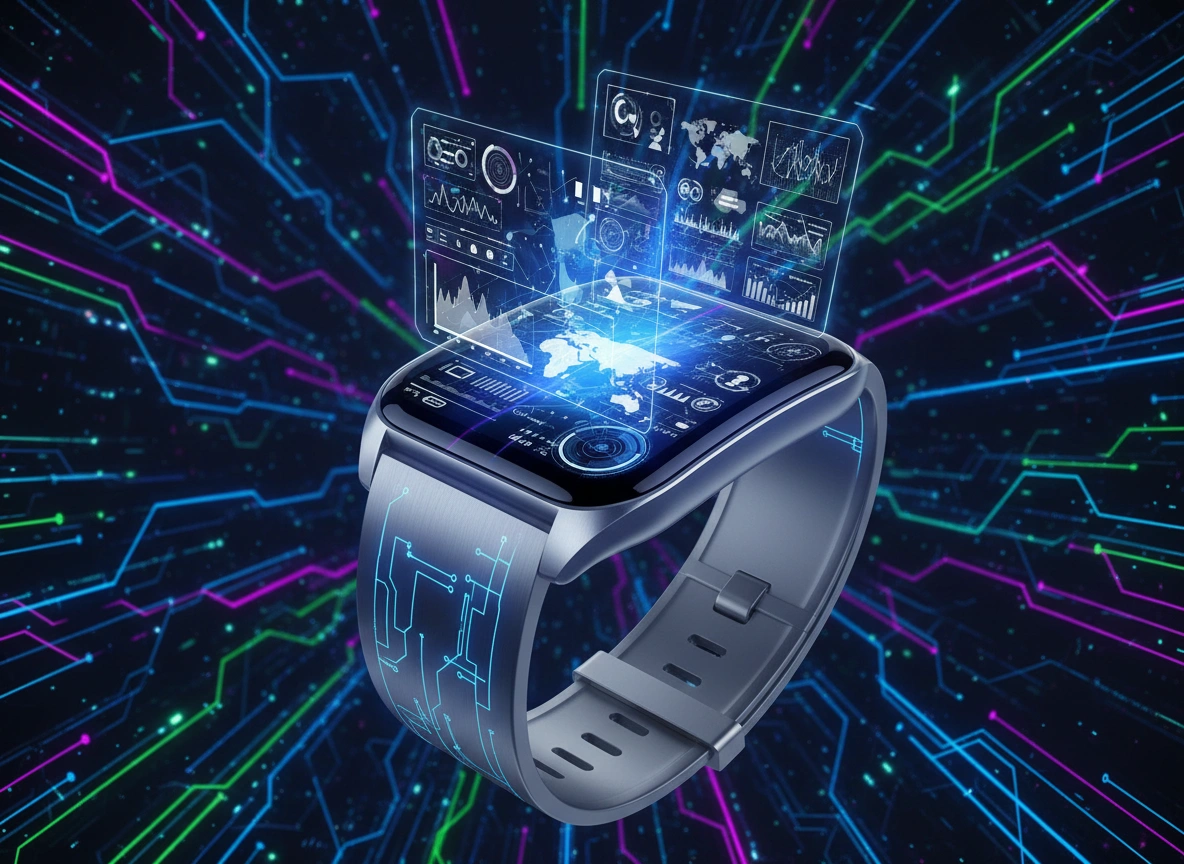
When the first modern smartwatches hit the market over a decade ago, they were largely viewed as notification mirrors for our phones. A buzz on the wrist meant an email, a text, or a calendar reminder. Fast forward to today, and these devices have become indispensable health companions, fitness coaches, and digital wallets. But technology never stands still. As we look toward 2026, the humble smartwatch is poised for another massive evolutionary leap.
The next generation of wearables won’t just track what you do; they will anticipate what you need. From non-invasive blood glucose monitoring to AI agents living on your wrist, the landscape of 2026 looks radically different from today. This article explores the specific features and technological breakthroughs we expect to see standardizing in the next few years.
The Holy Grail of Health: Non-Invasive Monitoring
For years, the “white whale” of wearable technology has been non-invasive blood glucose monitoring. By 2026, we expect this feature to finally move from the lab to the wrist.
Continuous Glucose Monitoring (CGM) Without Needles
Currently, diabetics rely on finger pricks or patches with small needles to monitor blood sugar. Major tech giants have been pouring resources into optical absorption spectroscopy. This technology uses light to detect glucose levels in the interstitial fluid just below the skin. By 2026, expect premium smartwatches to offer this as a headline feature. It won’t just be for diabetics; biohackers and fitness enthusiasts will use it to optimize their diet and energy levels in real-time, receiving alerts when a sugary snack causes a spike that might lead to a crash later.
Advanced Blood Pressure Tracking
While some watches currently offer blood pressure estimates, they often require calibration with a traditional cuff. Future iterations will utilize more advanced photoplethysmography (PPG) sensors combined with machine learning algorithms to provide medical-grade accuracy without the need for periodic calibration. This continuous monitoring could be a lifesaver for detecting hypertension early, dubbed the “silent killer.”
Hydration and Lactate Sensors
Beyond heart rate, athletes crave more data. By 2026, we anticipate the integration of micro-fluidic sensors capable of analyzing sweat. This allows for real-time hydration tracking—telling you exactly how much water to drink during a marathon—and lactate threshold monitoring, helping runners and cyclists push their limits without burning out.
AI on the Edge: The Assistant on Your Wrist
Artificial Intelligence is currently cloud-based for most heavy lifting. You ask Siri or Google Assistant a question, and the data travels to a server farm and back. The future is “Edge AI,” where processing happens directly on the device.
Proactive Personal Assistants
Imagine an AI that understands your context without you speaking. If your heart rate spikes during a meeting, your watch might discreetly suggest a breathing exercise or draft a message to your next appointment saying you’re running late due to stress. By 2026, On-device Large Language Models (LLMs) will be optimized for the low-power chips in wearables. Your watch will summarize your emails, translate foreign languages in real-time during travel, and manage your schedule based on your energy levels—all without needing an internet connection.
Emotion Recognition
This may sound like science fiction, but “affective computing” is a rapidly growing field. By analyzing Heart Rate Variability (HRV), skin temperature, and galvanic skin response, 2026 smartwatches could detect your emotional state. This isn’t just a novelty; it has profound implications for mental health. The device could correlate anxiety spikes with specific locations, people, or times of day, helping users identify and manage triggers they weren’t consciously aware of.
The Energy Revolution: Battery Life Breakthroughs
The biggest complaint about current high-end smartwatches is battery life. A device that tracks your sleep shouldn’t need to be charged while you sleep. Several technologies are converging to solve this by 2026.
Solid-State Batteries
The industry is slowly shifting away from traditional lithium-ion liquid electrolytes toward solid-state batteries. These are safer, hold a higher energy density, and degrade slower. A shift to solid-state could arguably double the battery life of current flagship models, making multi-day battery life the standard rather than the exception for full-featured watches.
Energy Harvesting
Why plug in your watch when your body produces heat and moves constantly? We expect to see hybrid charging solutions become mainstream. Advancements in piezoelectric materials (harvesting energy from motion) and thermoelectric generators (harvesting energy from body heat) could provide a constant “trickle charge” to the battery. While this likely won’t replace the charger entirely, it could extend battery life significantly, perhaps indefinitely in low-power modes.
Solar-Integrated Displays
Transparent solar cells built directly into the display glass are already appearing in niche adventure watches. By 2026, efficiency improvements will allow these to be invisible layers on mainstream OLED or MicroLED screens, constantly topping up the battery whenever you are outdoors or in a well-lit room.
Seamless Integration: The Center of the IoT Web
Your smartwatch in 2026 will act as a primary authentication token and controller for the Internet of Things (IoT).
Ultrawide Band (UWB) Dominance
Bluetooth is great, but UWB offers spatial awareness. Your watch will know exactly where you are in a room. As you walk toward your car, it unlocks. As you approach your smart thermostat, the interface appears on your wrist automatically. Point your watch at a smart light bulb, and the controls for that specific bulb pop up. This context-aware control removes the friction of digging through apps to find the right switch.
Gesture Control 2.0
We are already seeing the beginnings of this with “double tap” gestures. By 2026, neural interfaces (potentially reading electrical signals from the wrist muscles) will allow for complex, subtle gestures. A rub of the fingers could turn up volume; a flick of the wrist could dismiss a call. This hands-free interaction is crucial for AR/VR integration, where the watch serves as a discrete controller for smart glasses.
Design and Display: The Era of MicroLED
The visual experience is set for an upgrade. The bulky, hockey-puck designs of the past are giving way to sleeker, more adaptable forms.
MicroLED Screens
MicroLED is the successor to OLED. It offers higher brightness, better color accuracy, and importantly, no risk of burn-in. It is also more energy-efficient. By 2026, this display technology will likely be standard in flagship wearables, allowing for screens that are easily readable even in direct, harsh sunlight.
Flexible and Modular Designs
We may see a move away from the rigid “watch face” toward flexible displays that wrap around the wrist, offering more screen real estate. Imagine a “cuff” style bracelet where the entire surface is an active display, allowing you to change the digital pattern to match your outfit instantly. Furthermore, modularity could allow users to swap out sensor “links” in the band—adding a pollution sensor for a city commute or an extra battery module for a camping trip.
Potential New Use Cases
As the technology matures, we will stop asking “what can a smartwatch do?” and start asking “what can’t it do?”
The Universal key
Physical keys and wallets will become increasingly obsolete. With advanced biometric security (like vein pattern recognition on the wrist), your watch becomes your verified identity. It will clear you through airport security, open your office door, start your car, and pay for your coffee, all with higher security than a fingerprint scanner.
Remote Patient Monitoring
Hospitals are looking to decentralize care. Post-surgery patients in 2026 might be sent home with a medical-grade smartwatch that streams vitals directly to their doctor. AI will monitor for signs of infection or distress (like a rising temperature or irregular heartbeat) and alert medical professionals instantly. This shift could drastically reduce hospital readmission rates.
Conclusion
The smartwatch of 2026 will be far more than a notification center. It is evolving into a proactive guardian of our health, a seamless interface for our digital lives, and a context-aware assistant that lives on our wrist.
For consumers, this means devices that require less maintenance (charging) while providing significantly more value. For the tech industry, it represents a shift from “gadget” to “essential utility.” Whether it’s detecting a health crisis before it happens or simply unlocking your front door as you approach with groceries, the wrist is about to become the most powerful piece of real estate on the human body.
Actionable Next Steps
If you are looking to upgrade your wearable tech soon, consider your timing.
- Wait if you can: If you are specifically interested in non-invasive glucose monitoring or MicroLED displays, the current generation of watches (2024-2025) is likely the “final form” of the old tech before the next big leap.
- Focus on Ecosystem: As features like UWB and AI integration grow, the connection between your phone, home, and watch becomes critical. Stick to one ecosystem (Apple, Google/Samsung, etc.) to ensure these future features work seamlessly.
The future is bright, connected, and sitting right on your wrist.
Please vist this website for more info